

A contractor on £500 a day is told by a high-street bank that they can borrow around £226,000. The same contractor, the same contract, the same week, assessed by a lender that understands contracting: over £500,000.
Nothing about the person changed. Only who was reading the numbers.
Two ways to read a contractor
The conventional assessment reads your company accounts — the salary you paid yourself plus the dividends you drew — and multiplies. For most contractors that produces a modest figure, because most contractors sensibly take a small salary and leave profit in the business.
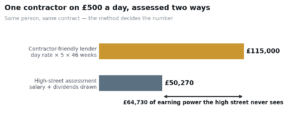
A contractor-friendly lender does something different. It largely sets the accounts aside and reads the contract. Your day rate is annualised, most commonly as day rate × 5 days × 46 weeks — 52 weeks less holiday and a buffer for gaps — and that becomes the income figure. Halifax pioneered the approach and Clydesdale, Kensington, Skipton and others now operate versions of it, some annualising over 48 weeks instead. It asks a different question: not what did you pay yourself, but what are you contracted to earn.
Why the gap is so wide
The gap is a direct consequence of doing the tax-efficient thing. A contractor billing £115,000 through their own company will typically take a £12,570 salary and draw dividends up to the £50,270 higher-rate threshold, stopping there because the next pound is taxed at 35.75% rather than 10.75%. The rest stays in the company for corporation tax and reserves.
That is ordinary, sensible practice. To a lender reading only what was drawn, it makes a £115,000 contractor look like a £50,270 one.
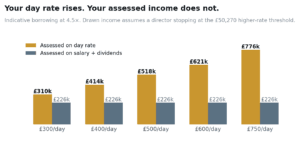
The second chart is the one worth sitting with. Borrowing assessed on your day rate climbs with the rate, as you would expect. Borrowing assessed on what you draw does not move at all — because a director following standard tax advice stops at the same threshold whether they bill £300 a day or £750. Work harder, charge more, and on paper you are no more creditworthy than you were.
It is worth knowing exactly where your own money goes before applying. The contractor and limited company calculator at payslp.com models a given day rate and salary-dividend split on 2026/27 rates, including corporation tax, employer’s National Insurance and dividend tax, with the working shown.
What you need to be read on your day rate
Day-rate assessment is not automatic. Broadly, lenders offering it want a current signed contract stating your rate and dates, usually with three to six months still to run; around twelve months of contracting history, though some will consider less where you have relevant experience; a pattern of renewals or continuous engagements; and short gaps between contracts. A CV is frequently requested alongside.
The strength of your position is essentially the strength of your evidence. A clean history with a current contract in hand puts you in front of a competitive set of lenders. A patchy record with long gaps narrows the field, and narrower fields price higher. This is where a broker who places contractor cases every week earns their fee — not in finding a rate, but in knowing which lender reads your particular shape of income most generously, and presenting it that way from the outset.

Your IR35 status changes the route rather than closing it. Outside IR35, paid gross into your own limited company, day-rate assessment is usually available and usually gives the strongest result. Inside IR35, paid through an umbrella, your payslip shows income after employer’s National Insurance and margin have been taken — which understates what the contract is actually worth. A number of lenders will still work from the gross day rate, and the difference is substantial.
The mistake is assuming inside-IR35 status means a standard employed assessment is all that is available. It often is not.
The short version
- Conventional lenders read your accounts. Contractor-friendly lenders read your contract — and the two produce very different numbers.
- Day rate × 5 × 46 weeks is the common annualisation. For a tax-efficient contractor that can be more than double the income a standard assessment would use.
- Your assessed income on the drawn basis barely moves as your day rate rises. On the day-rate basis it scales directly.
- A current signed contract and a clean contracting record are what unlock the better assessment. Inside IR35 narrows the options but rarely removes them.
Figures and sources: Day-rate annualisation of day rate × 5 × 46 weeks reflects published lender practice, including Halifax; some lenders use 48 weeks. Borrowing shown at 4.5× income, the common standard, though 5× and above is available to some applicants. Tax figures for 2026/27 per HMRC and gov.uk, calculated using payslp.com: corporation tax 19% to £50,000 with marginal relief thereafter, employer’s NI 15% above £5,000, dividend tax 10.75% basic and 35.75% higher.
Written by Matthew Newton of payslp.com, a free UK salary and take-home calculator. For information only and not financial, tax or mortgage advice. Your home may be repossessed if you do not keep up repayments on your mortgage.